


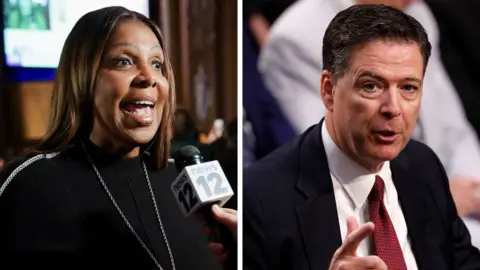
Two high-profile critics of former President Trump secured significant legal victories on Monday when a federal judge dismissed the government's charges filed against them.
For weeks since their indictments, former FBI Director James Comey and New York Attorney General Letitia James have maintained vehemently that they are not guilty, asserting that the administration and DOJ are simply singling out them for revenge.
US District Judge Cameron Currie tossed the indictments against them due to prosecutor Lindsey Halligan's invalid appointment as US attorney. But she also left the door open for the government to refile the case.
- Court throws out cases against ex-FBI director Comey and New York AG James
- US judge says government 'missteps' may have compromised Comey case
- What is ex-FBI director James Comey charged with?
Comey admitted that possibility after the ruling, stating he thinks the former president is likely to come after him once more.
And White House spokeswoman Abigail Jackson appeared to agree: This isn't the last chapter on this matter.
But the government confronts significant obstacles to successfully prosecute either after this defeat, and experts are reluctant to predict what could occur next due to the cases' unprecedented nature.
It feels to me like unexplored legal ground, stated Professor Kay Levine, law professor at Emory University.
Might the DOJ appeal?
The DOJ can contest Judge Currie's ruling before a federal appeals court. In this case, that would be the Fourth Circuit Court of Appeals.
US Attorney General Pam Bondi indicated she would pursue this option, pledging to use all legal means, including an immediate appeal.
Previously, the Trump administration has strongly challenged adverse decisions, moving cases from lower courts and sometimes accelerating its petitions up to the US Supreme Court.
Attorney Abbe Lowell, James's lawyer, vowed to continue to challenge any further politically motivated charges through all legal avenues.
In the event of an appeals process, the justice department likely would have its own attorneys argue the case, making Halligan's involvement in the appeal uncertain.
Is it possible there be new charges?
The government charged Comey with making false statements to lawmakers and obstruction of justice. Federal prosecutors charged James with bank fraud and making false statements to a financial institution.
Both entered not guilty pleas. Besides arguing Halligan was unlawfully appointed, they also claimed to be targets of retaliatory legal action.
With the original indictments thrown out (although appeals might alter this), the government might try to convene new grand juries and secure new charges.
As far as everything I've seen, a different attorney could present James's case to a different grand jury and secure a new indictment, stated Professor Levine.
But John Day, head of the American College of Trial Lawyers, said it could be a complicated path – certainly in Comey's case.
I can tell you it will be hotly contested, whether Comey's case can be recharged if a lawfully appointed prosecutor is assigned and is able to secure an charge.
He characterized the tangle of attorneys, judges, and legal filings involved as a legal quagmire with no easy solutions.
It might be more difficult for the government to try to file the identical accusations against James Comey.
One problem is the legal time limit – the deadline that government lawyers had to charge him for these specific allegations – which expired at the end of September. However, the dismissal of the charges would trigger a half-year extension for the justice department to refile the case.
Even so in that situation, his lawyers said it intends to argue the government is past the deadline.
The decision further indicates that because the charge is void, the statute of limitations has run and there can be no new indictment, lawyer Patrick Fitzgerald said Monday.
What happens to Lindsey Halligan?
In the pair of rulings on the charges against Comey and James, the judge was direct: Halligan's appointment was improper.
Judge Currie wrote in the James ruling that the Attorney General's attempt to appoint Ms. Halligan as Acting US Attorney for the Virginia Eastern District was unlawful.
Therefore, she lacked legal power to file the charges, she wrote.
Federal prosecutors are nominated by the president and need Senate approval. Federal statutes regulate how individuals can be assigned on a interim basis, but the judge determined that Halligan's assignment had breached these regulations.
That leaves Halligan's position on future cases against James and Comey, once more, uncertain.
The decision might also cast a shadow on other cases Halligan has brought in the Virginia Eastern District where she serves.
But Bondi said on Monday that she made Halligan a special federal prosecutor and commended her work as excellent.
The administration stood by its stance that Halligan was lawfully appointed, spokesperson Karoline Leavitt told the press on Monday.


